
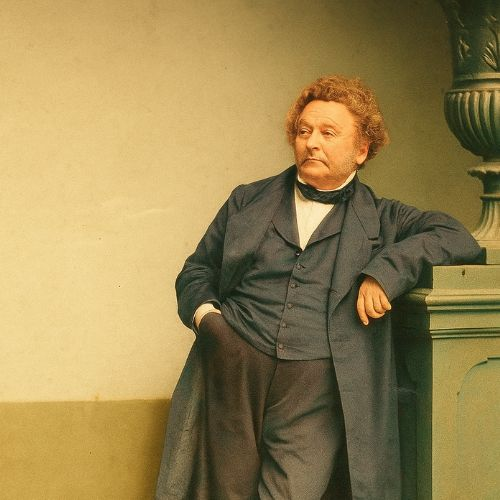

Adolphe Crémieux
Adolphe Crémieux was born in Nîmes in 1796 to David Crémieux and Rachel Carcassonne, a family of silk merchants. The surname “Crémieux” came from a town near Lyon with a historic Jewish community. (Jewish families did not traditionally use fixed surnames — these were imposed later during Napoleon’s era.)
Crémieux descended from the “Jews of the Pope,” a unique community living in the papal territories of Avignon and the Comtat Venaissin. His parents supported the French Revolution, which had granted civil liberties to Jews after centuries of confinement in ghettos. History may not repeat, but it certainly rhymes. This moment echoed the biblical story of Moses leading the Jews out of slavery in Egypt after 450 years. Once free, Jewish communities participated more fully in the economy. Many excelled, especially in trade and finance — fields that had historically remained open to them — with families like the Rothschilds rising to international prominence. The liberation owed much to figures like Gabriel Riqueti, the Marquis de Mirabeau, who famously declared after meeting Jewish communities in Europe: “The Jew is more of a man than he is a Jew.” He was later honoured by the first Jewish Mayor of Aix and France Bedariddes.
At the time, most European Jews — nearly two million — were Ashkenazi, living in Poland and Russia. But in France, Enlightenment ideas gave a small but well-educated Jewish minority in the West (around 30,000 in France) an influential voice. Among them, Crémieux was one of the loudest.
He was one of the first Jews admitted to the Paris Imperial High School. Later he studied law in Aix-en-Provence, where he developed a passion for theatre and cultivated his extraordinary oratorical ability — described by his teachers as “exuberant eloquence, rapid reasoning, and an extraordinary memory.” He passed the bar exam in Nîmes in 1817.
One of his first major campaigns was abolishing the Judaic Oath — the serment more judaico — a humiliating medieval practice that gave Jews only partial legal standing in court. When a judge questioned him about his Jewish identity, Crémieux famously replied:
“Am I in a synagogue? No, I am in court.
Am I in Jerusalem? No, I am in Nîmes, France.
Am I only a Jew? No — I am also a French citizen.”
Crémieux was Jewish, but he was also deeply French. When critics claimed that Jews had loyalties “beyond the nation,” Crémieux proved otherwise. In 1819, he defended three young men arrested for singing La Marseillaise, which had been banned under Napoleon. Before defending them, he sang the anthem himself in court. The jurors rose — and acquitted the accused.
In 1827, his defence of Jossias Vidal regarding the Judaic Oath made him nationally famous.
After the July Revolution of 1830, he moved to Paris, spending seven years at the Court of Appeal, where he defended victims of political persecution and even enslaved people in Martinique accused of rebellion.
A turning point came with the Damascus Affair of 1840, in which 13 Jews were falsely accused of ritual murder in Syria. Crémieux denounced the accusations as slander and mobilized Western Jewish communities — especially in Britain — to intervene. James de Rothschild in Paris attempted to help, but official French policy supported Egypt at the time. Crémieux then travelled to England, where Nathaniel de Rothschild secured backing from the British Crown including a cheque for £1000. A delegation was sent to Egypt and was warmly received. This new solidarity among global Jewish communities led to the founding of the Alliance Israélite Universelle in 1860 which still runs today.
In 1842, Crémieux entered international politics, condemning Switzerland for discriminatory laws targeting Jews. In 1843, he became president of the Central Consistory of French Jews — but resigned after learning that his wife had secretly converted to Catholicism and baptized their daughters.
During the Revolution of 1848, he helped King Louis-Philippe escape France. Soon after, he became Minister of Justice, where he abolished imprisonment for debt, ended the public shaming of convicts, promoted women’s education, and advanced protections for women.
In 1851, he was arrested for opposing Bonapartism. He spent years focusing on Jewish issues before returning to politics in 1869. He refused to swear loyalty to Napoleon III, defended Charles Hugo (Victor Hugo’s son) in court, and played a role in movements that contributed to the fall of the Second Empire.
In 1868, he became president of the AIU, championing education for boys and girls across Jewish communities worldwide. He authored the Crémieux Decree of 1870, granting French citizenship to Jews in Algeria — a decree later revoked under Vichy.
He died on 10 February 1880. Every year, a memorial service honoring him is still held in Paris’s Portuguese Synagogue. He remains one of the most influential Jewish figures of the 19th century — a defender of minorities and justice. He once wrote:
“Ah! The difficulties of life! But they are the most beautiful thing in the world…When one is stopped by an obstacle, one feels it must be overcome — and one wants to overcome it.” Adolphe Crémieux
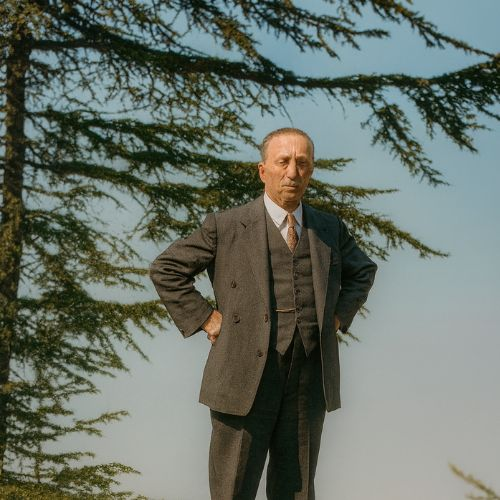
Marcel Cremiuex
In Aix, at the Place des Martyrs de la Résistance, we find the name Marcel Crémieux. Marcel was an ordinary man running a fabric-trading business between Aix, Milan, and Lyon. Everything changed in 1942, when the Nazis occupied the region after the collapse of Vichy France.
Around 10,000 Nazi soldiers, working with the local Mafia known as the French Connection, hunted Jews and other “undesirable” populations using bounties. Marcel tried to hide in the countryside but was betrayed. A bounty of roughly €1,000 in today’s money was offered for information leading to arrests.
He was transported from Nice to Paris by train, then on to Auschwitz. He never returned.
His grandson survived by hiding in a convent in the Luberon. When the Nazis approached, the children hid in caves in the surrounding hills. They were fortunate enough to return after the liberation. Thankfully his son survived —
Marcel Crémieux is my great-grandfather.