

In the 16th century, after the French annexation, the Provençal people themselves became a minority in their own land. Their language declined steadily. In the 19th century, seven poets and writers gathered to preserve it — the Félibres, led by Frédéric Mistral.
Named after the powerful mistral wind, the Mistral family was deeply Provençal. Frédéric Mistral studied law and history in Aix from 1848 to 1851. Provençal (Occitan) had once been a major literary language in the 12th century, shaped by a blend of Christian, Arabic, and Latin influences. But after the annexation, the French replaced it almost entirely. Mistral dedicated his life to reviving it, writing poetry and compiling a monumental dictionary.
During Aix’s sleepy development, a man of Italian descent named Louis Auguste Cezanne, found commercial success as a millener and as a banker. His son became a legend in the Artistic world but was treated by the locals as an outsider. Cezanne was a spiritual man who didn’t fit into the French bourgeois materialism world – what people might call mainstream consumerism culture that exists today. He flipped the artistic world by deconstructing it and moving away from impression to expressionism – thus modern art was born.
In the early 20th century, Marcel Provence — born Marcel Joannon in Marseille — carried this mission forward. A lover of the arts, he opened a theatre in Aix and helped found museums such as the Musée du Vieil Aix. He bought Cézanne’s studio and preserved it faithfully, living inside it until his death in 1951.
After he died, the studio went up for sale. Parisian developers wanted to tear it down and build apartments.
But another minority stepped in: Leo Marchutz and John Rewald, both German-born Jewish artists who had come to Aix in the 1920s and 30s to study Cézanne. Forced to flee during the war, they returned afterward with determination. They mobilized American supporters and raised the funds needed to save Cézanne’s atelier — the studio we can still visit today.
Remarkably, it was two foreigners who protected a local artist more faithfully than the local authorities.
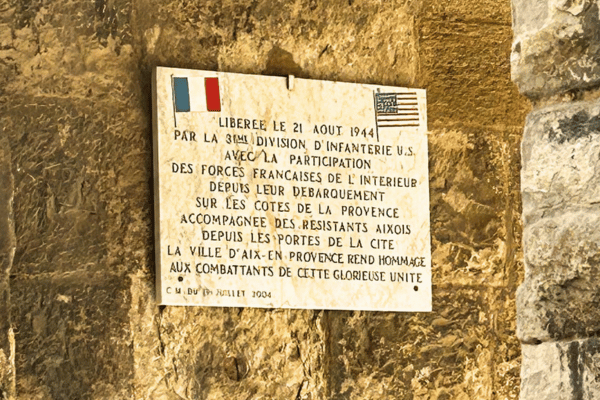
At the same time, American soldiers who helped liberate Provence in 1944 fell in love with the region. Although nearly 7,000 Americans died on Provençal soil, and the 3000+ Americans buried at a local necropolis cemetery is testament to their sacrifice, many survivors however carried back stories of its beauty.
In the post-war years, Provence became part of the “American dream.” Rosé wine transformed from a poor man’s drink into a fashionable symbol of Mediterranean life. Writers like Hemingway admired Cézanne’s vision.
After 1953, with the founding of the Université de Provence, American students began arriving in large numbers. Much like Roman elites once sent their children to Marseille to learn Greek culture, Americans now sent theirs to Provence to study French language, art, and life.
“I learned to understand Cézanne much better and to see truly how he made landscapes when I was hungry. I used to wonder if he were hungry too when he painted; but I thought possibly it was only that he had forgotten to eat. It was one of those unsound but illuminating thoughts you have when you have been sleepless or hungry. Later I thought Cézanne was probably hungry in a different way.” – Ernest Hemingway
Sadly the Americans did bring a negative, a disease that affected the Plane trees, brought from inside the Ammunition boxes made with a wood non native to Europe. Just like with the Elm trees, the plane trees have been decimated, and thus new trees have been planted, signalling a new era for the city’s green spaces.