
Another minority present in Provence for more than 2,000 years — in myth and in memory — are the Romani people. Originally from India, they migrated westward over many centuries, eventually reaching the Balkans, a region known for its rich, dark, fertile soil.
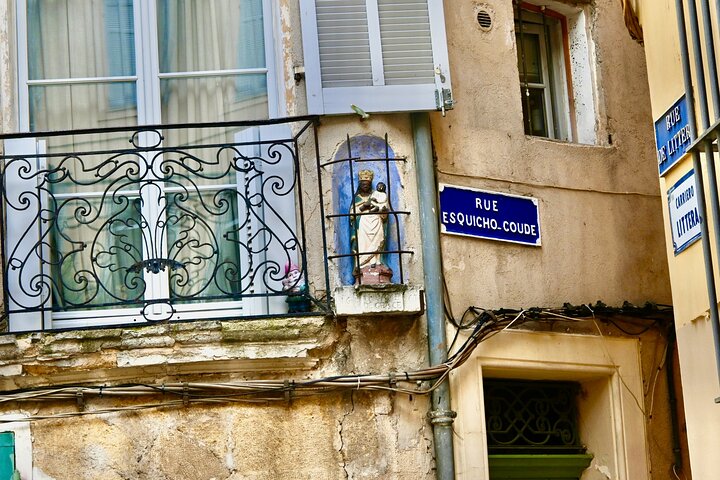
In Aix, on the Rue Escucho Coude (“the road of the crushed elbow”), stands the Oratory of the Black Virgin. She is said to represent Sara, the Black servant of Mary Magdalene — a Somali woman who, according to tradition, helped at Jesus’ birth and later served the Holy Family. In parts of the Middle East today, it remains common for families to have live-in domestic workers from places like Somalia or Ethiopia.
According to legend, Sara arrived in the Camargue with Mary and was received with reverence by the Romani people, who consider her their patron saint. Each May, thousands of Romani and non-Romani pilgrims converge on Saintes-Maries-de-la-Mer to honour her, carrying her statue into the sea — just as the Golden Legend describes her arrival by boat.
The darkness of the Black Virgin symbolises both Sara’s origins and our connection to the earth — the richest soil being the darkest. Even Jesus said, “I am the bread and the wine,” reminding us that we are shaped by the land that feeds us.
Black Virgin oratories can be found throughout Provence and across the Mediterranean — in places like Barcelona — subtle markers of the deep, multicultural roots of this region. That being said, the Black Madonna is quite unheard of, and while most depictions of Mary show a white woman, it’s a rare symbolism of inclusivity within the Christian Church.
The one in Aix is by far one of the oldest, showing that once again, the oratory which became so popular around the city was led by a small minority.